Being a medieval historian is weird, in general. I spend a lot of time reading and thinking about a thousand years of history which is largely ignored. When I do manage to then attempt to share my love (or obsession, if you want to be a dick about it) I am often met very specifically with pushback from people who have a deeply held, preconceived idea of the medieval period as ‘violent, dark, and dirty.’ Admittedly my experience could be anecdata. Maybe there is something about being so so cute and fun that makes haters flock to me, specifically, to say incorrect things. However, luckily for me I had a chance to actually look at some honest to god data about this, thanks to the hard work of David Montgomery, Senior Data Journalist at yougov, who blessedly took the time to poll a bunch of Americans to see what they thought about the best millennium. In my opinion these results say a lot about society, so we’re gonna look at them today.
Read more: On what Americans know about medieval history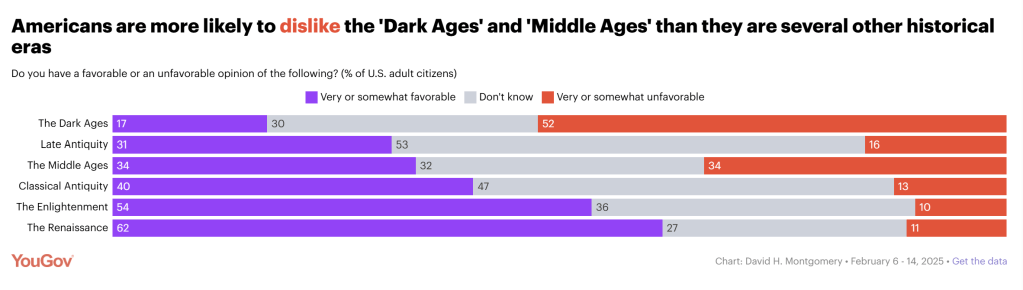
So let’s start off with the first poll. Now I am not a huge fan of attempting to demarcate the so-called Dark Ages, or early Middle Ages, from the rest of the Middle Ages, but overall this is instructive. I … am not unhappy with the number of people who view the Middle Ages positively? Thirty-four percent is pretty good, given the amount of bad press we are constantly having to work against. What is not good is that an equal number of people still have an unfavourable opinion of the medieval period. Even worse, the poor Dark Ages are languishing at only seventeen-percent favourability, with fifty-two percent of people being ignorant weirdos about it. I know I go on about this all the time, but it is hugely ironic that a bunch pf people who literally don’t know anything about the Early Middle Ages therefore blame that period for their own laziness. Like yeah man, those were the stupid people. Not you, the person who probably couldn’t even point to the period on a timeline.
It’s also interesting to see how influence propaganda has on these opinions. We have a sixty-two percent favourability rating for the god-damned Renaissance. The irony here is I am almost certain that if I asked these Renaissance lovers why they liked it so much they would say something about emerging from the superstition, bigotry, and ignorance of the medieval period. Like yeah man, I simply love the period when *checks notes* persecution of gay people increases, life expectancy decreases, Europe experiences the witch trials, and the Church goes full Borgia Pope. What’s your favourite thing about the Renaissance? The advent of syphilis? Or the violent subjugation and colonisation of the Americas? It’s so hard to pick because it’s just a really beautiful time to be alive, you know?[1]
But that doesn’t matter, because the Renaissance has great PR. When you are taught about it in American schools, everyone just gushes about Michelangelo and the Medici’s great art collection. They gloss over the fact that most people aren’t rich assholes who get to look at and collect said art. Contrast this with the medieval period, which we are just not taught about, and you can see where the problem lies.
More specifically however, there is a unique dislike of the medieval period beyond just generalised ignorance. Contrast the Middle Ages and Dark Ages with Late Antiquity here and we get an interesting phenomenon – people don’t know much about Late Antiquity, so they just say ‘I don’t know’. But everyone has an opinion on the Middle Ages, which is completely unwarranted. I am blaming Voltaire for this, obviously.
So, overall, I think we see here a slightly better attitude to the Middle Ages than expected, but yo, it hurts to get beat by Classical Antiquity. A period that people also don’t know about but still believe the hype on.
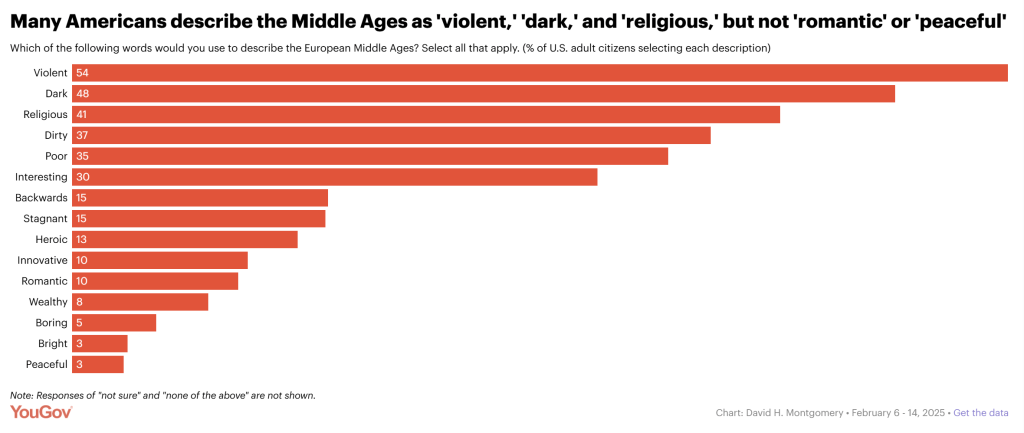
The second poll just makes my feelings on this worse. Why don’t people like the Middle Ages? Well, because it was, according to them, ‘violent, dark, religious, dirty, and poor’. And like, my brothers in Christ – how is this different from the Renaissance, which you were just telling me you wanted to jack off? I am not here to tell you that the medieval period is a specifically peaceful time, but it pales in comparison to what goes down in the early modern period, in which both the apparently beloved Renaissance and Enlightenment periods lie.
During the early modern period wars become larger and weapons more deadly, and attendant death rates go up. So how is that also not … dark? As for ‘religious’, um, uh, um have you met the early modern period? That is the most violently religious time period for Europeans! The thirty years war? The witch panics? Using religion as a justification for violent settler colonialism and chattel slavery? Modern things! Being done most modernly! I am not here to tell you the medieval period wasn’t religious – it absolutely was. But my point is that if you are gonna call it religious and respond to that negatively, then you also need to be mad at literally every other time period in this poll and you aren’t. So there is a specific bias here.
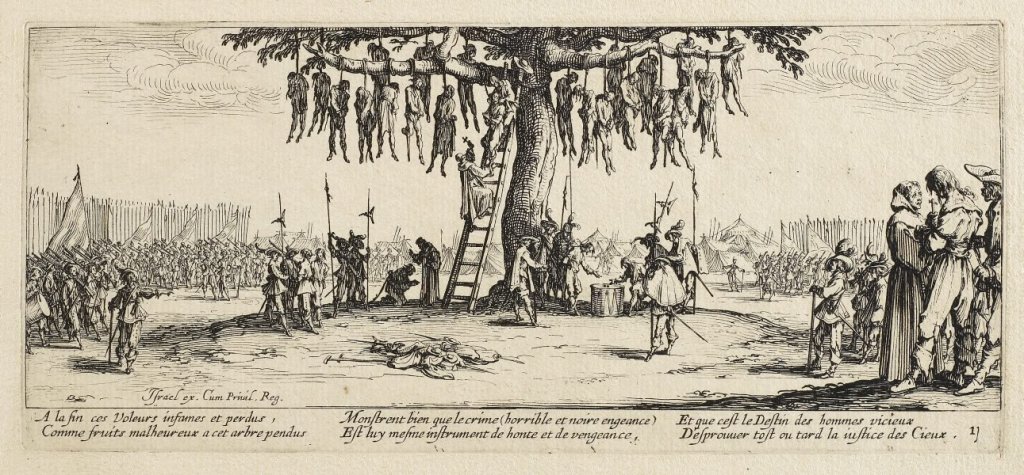
As for the ‘dirty’ thing? Medieval people bathed. Medieval people bathed. OH MY GOD MEDIEVAL PEOPLE BATHED I AM SO TIRED OF YOU PEOPLE.
To be fair, it’s not all bad, and Montgomery notes that when ‘[a]sked to choose between two views of the Middle Ages — neither of them particularly positive — 48% of Americans say “it was a dark age and things were objectively worse in this period than what came before and what came after,” while 52% say “it was a complicated, messy period neither better nor worse than any other.”
Younger Americans and those who say they know more about the Middle Ages were more likely to say it was neither better nor worse than any other period, while older Americans and those who know less about the Middle Ages were more likely to call them a dark age.’[2]
So, the young people are absolutely coming to bat for the medieval period, and frankly, I love to see it. This gives me some personal hope because apparently people are listening to us when we write histories and Americans are improving as a cohort as a result. I am gonna try not to focus on how older people do run their mouths about things they don’t know and take the very small w. Thanks very much.
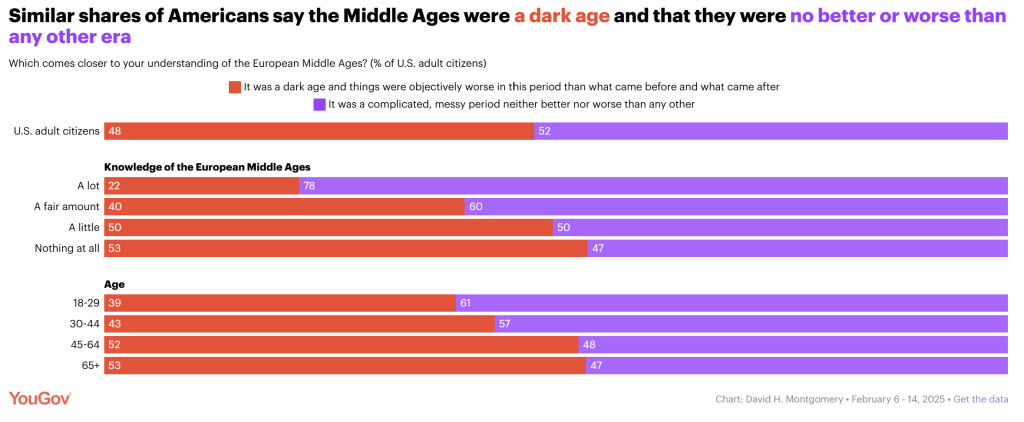
Clearly as well we see that the more people know about the medieval period, the more likely they are to be correct about it. I do find it interesting that people who admit that they only know ‘a little’ about it, immediately slam their hands down on the ‘negative’ button, with (surprise!) the biggest cohort of haters knowing ‘nothing at all’. How – how I ask you – do you blithely admit you don’t know what you are talking about, and then announce that a thousand year period is bad? Pretty easily apparently, but still!
I would challenge this forty percent of people who claim they ‘know a fair amount’ about the medieval period and say it’s a bad time, however. Like babe, is that the medieval period, or are you just blaming medieval period for the early modern period again? There are many such cases!
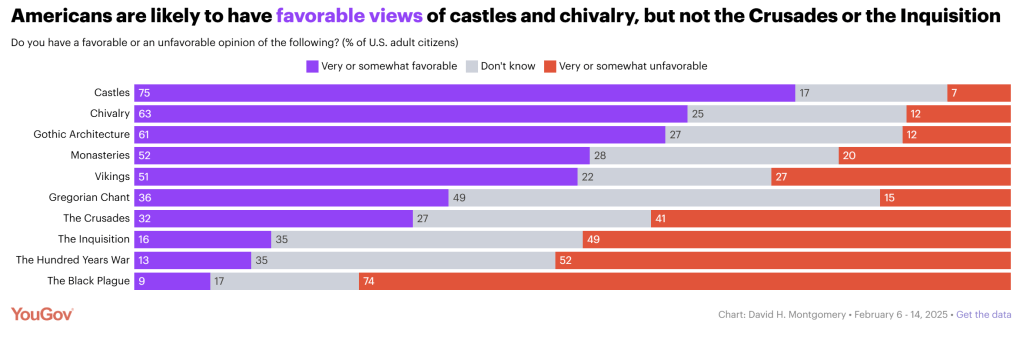
What I love is this section where everyone is pretty much bang on the money. Castles are sweet as hell, it’s so true! Gothic architecture? I love that shit!! YES!!! Also the Crusades, Inquisition, Hundred Years War, and Black Death all suck. I’m not saying they aren’t interesting, I am saying I think that people suffered terribly as a result of them and so you should, in fact, dislike them if asked to do so.
If you are enjoying this post, why not support the blog by subscribing to the Patreon, from as little as £ 1 per month? It keeps the blog going, and you also get extra content. If not, that is chill too.
I only have a few minor quibbles here. The first, is that I personally don’t count the Inquisition – which you absolutely should have a negative opinion on – as medieval. For me, by the time Ferdinand and Isabella unite Spain, that kingdom is in the modern period. Just like I find the Columbian expeditions to be Early Modern, not medieval. However, I can also accept why people might call it medieval just based on the date. For me, it does feel like it gets called medieval because it sucks though.
The second is identifying chivalry as a nebulous good, when in fact probably people don’t know what it is. I suppose I should be taking all the good press I can get, however.

I also find it super interesting that if you press people about actual individuals who lived in the medieval period, they start admitting that they don’t know what they are talking about. Here we have ten of the biggest names from the period (in Europe, anyway) and most people are like ‘Yeahhhhhh I don’t know her.’ I do think it is cute that people like Joan of Arc a lot though. I think that we gotta drop Richard the Lionheart’s numbers right down though. I am attributing his high favourability to Robin Hood stuff, but I am still taking it seriously that everyone likes him but doesn’t like his mom??? Justice for Eleanor of Aquitaine! Also the nine percent of people who don’t like Hildegard of Bingen – I just want to talk. Who hurt you??

I also love that more Americans say they are thinking about the Middle Ages than the Roman Empire. That is good and proper. Thank you. I do, however, wonder what said people are thinking about, given the weird scores and negativity above, and the fact that they apparently don’t know anyone’s names.
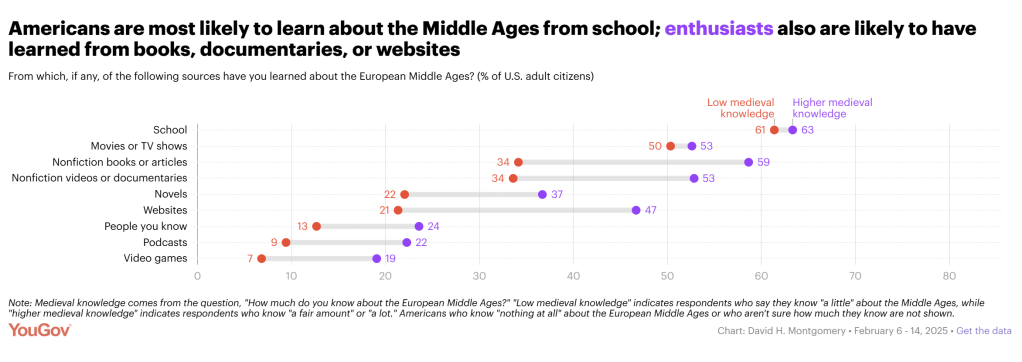
I am also interested in this section of the poll where people say they got most of their information about the medieval period from ‘school’ cuz – girl, when? I went to Catholic school for sixteen (16) years in America. We barely got any information about the medieval period! I was presented with, ‘Hmm yeah, 1066. Magna Carta?? Anyway, here’s the Renaissance’ until I got to uni. I just feel flummoxed by the idea that serious pedagogy on the medieval period is actually happening in America, but that I, a person who hung out with Jesuits for eight years, did not somehow receive it.
Also my feelings on this one are born out by the next couple of polls which show people have no idea what they are talking about.
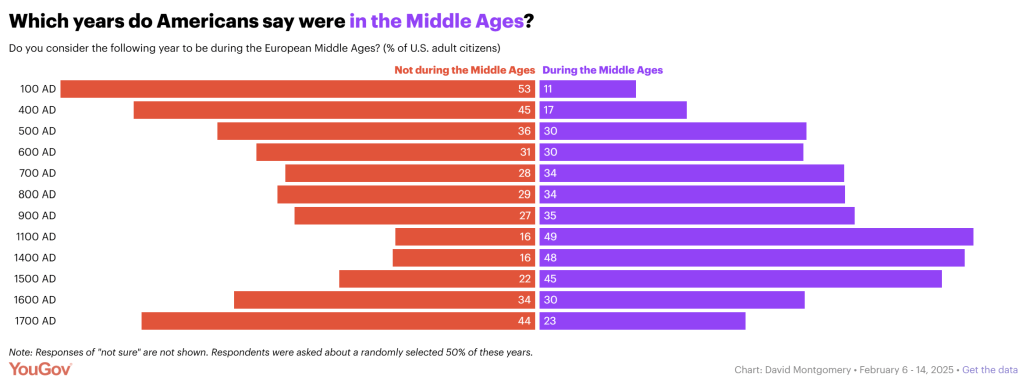
I mean not even half of respondents can tell you when the Middle Ages were happenoing correctly. Yes, I concede that we don’t have a specific time frame, but as a general rule of thumb 476 to 1517 works as a quick and dirty rule, right? AND YET! Not even half of you bitches can identify 1100 – the most medievaly time that ever medievaled – as the Middle Ages and you are still somehow mad at them?? Come now. Also if you are learning so much about them in school why can’t you define them? CASE CLOSED. (The case is not closed.)
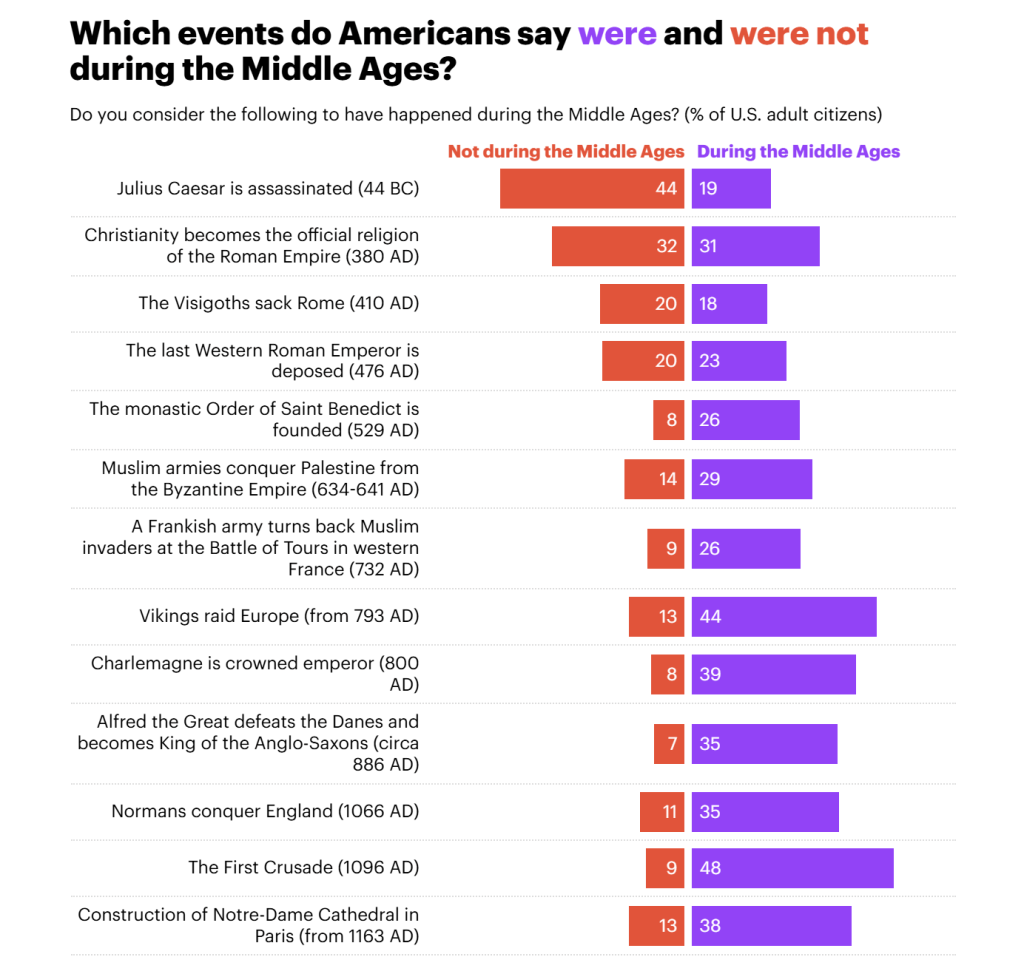
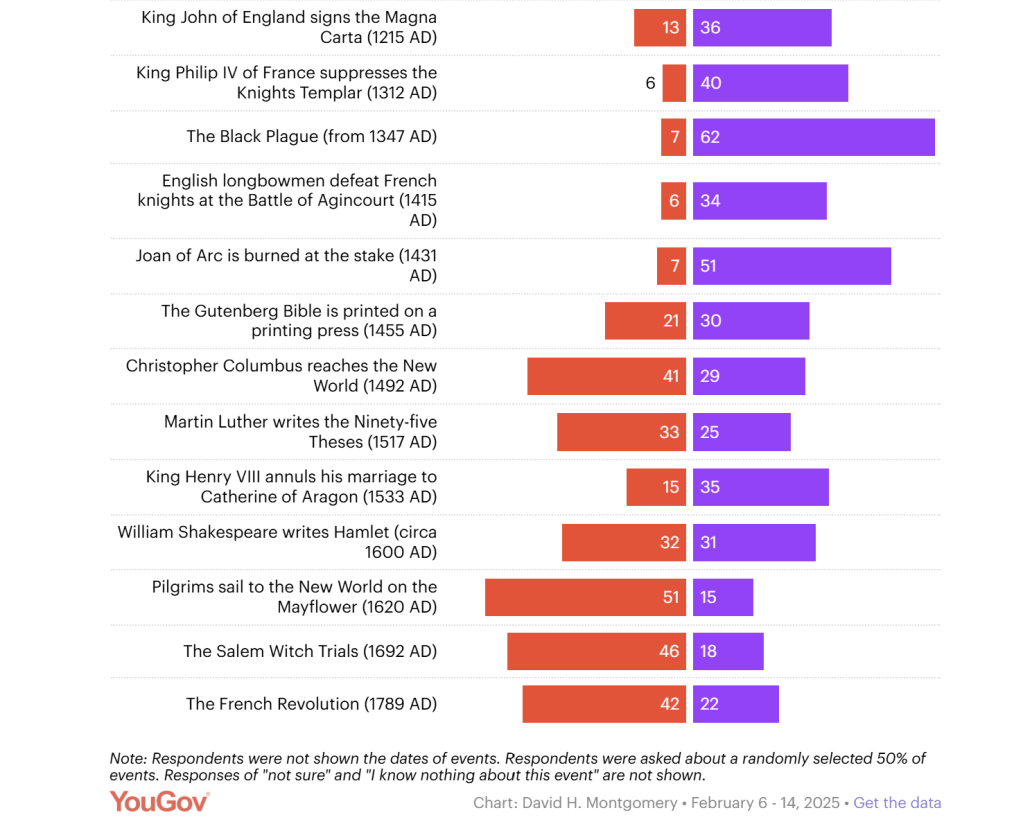
But here is the thing, again, I feel like the people responding to this poll did not learn about medieval history in school, given that the only two events which more than half of people could correctly attribute to happening in the medieval period are the death of Joan of Arc and the Black Death. The same number of people attribute Magna Carta being signed to the medieval period as do attribute Henry VIII getting divorced to the medieval period. These are arguably the two most medieval and early modern things to happen in England during each period, respectively. So forgive me if I don’t take you at your word that you learned about the period in school when apparently thirty-one percent of you think that Rome adopted Christianity during the medieval period.
Now to be fair to those polled, these answers show that, once again, a lot of people abstained from identifying when they felt these events happened, and that is actually really smart and correct. I think that if you don’t know something the smartest thing you can possibly do is just say so.
Still, having said that, if you don’t know about something I think it’s also probably a really good idea to not pass value judgements on it! Would I rather that people know about the medieval period? Yes, obviously that is what I have devoted my life to doing, for some fucking reason. However, if knowing about medieval history isn’t for you, I think the least you could do is shut the fuck up about it being bad. This stuff is above your pay grade, and that is fine.
In order to not meet hateration with hateration, I want to end on a positive note. I think it’s fucking great that younger people are learning more about the medieval period, and are being more nuanced with their evaluation of it. I think it’s great if people are learning about the medieval period in school. (I doubt they are, but still!) I also think it’s cool that the badassery of Joan of Arc manages to cut through hundreds of years. Long may this continue! It makes me feel less alone. I also think it’s great that this poll was conducted at all. Thank you so much to David Montgomery for this food for thought. It helps me what to plan next.
[1] For more on how the time period of the Renaissance was, in fact, a shit show, I cannot recommend Ada Palmer’s amazing new book, Inventing the Renaissance: The Myth of a Golden Age, (Chicago: Chicago University Press, 2025), enough. She’s an actual honest to god Renaissance historian and would be the first one to back me up on all this. Hell, I got half of these opinions from reading her excellent work. Do get it!
[2] https://today.yougov.com/entertainment/articles/51889-violent-dark-dirty-americans-middle-ages, <Accessed 30 April 2025>
For more on misconceptions about the medieval period, see:
There’s no such thing as the Dark Ages, but OK
I assure you, medieval people bathed
On cats
On fake medieval devices both torture and sexual
That’s not what chivalry is, but OK
Support the blog by subscribing to the Patreon, from as little as £ 1 per month! It’s the cool thing to do!
My book, The Once And Future Sex: Going Medieval on Women’s Roles in Society, is out now.

© Eleanor Janega, 2025

 Going Medieval