On contrarian history

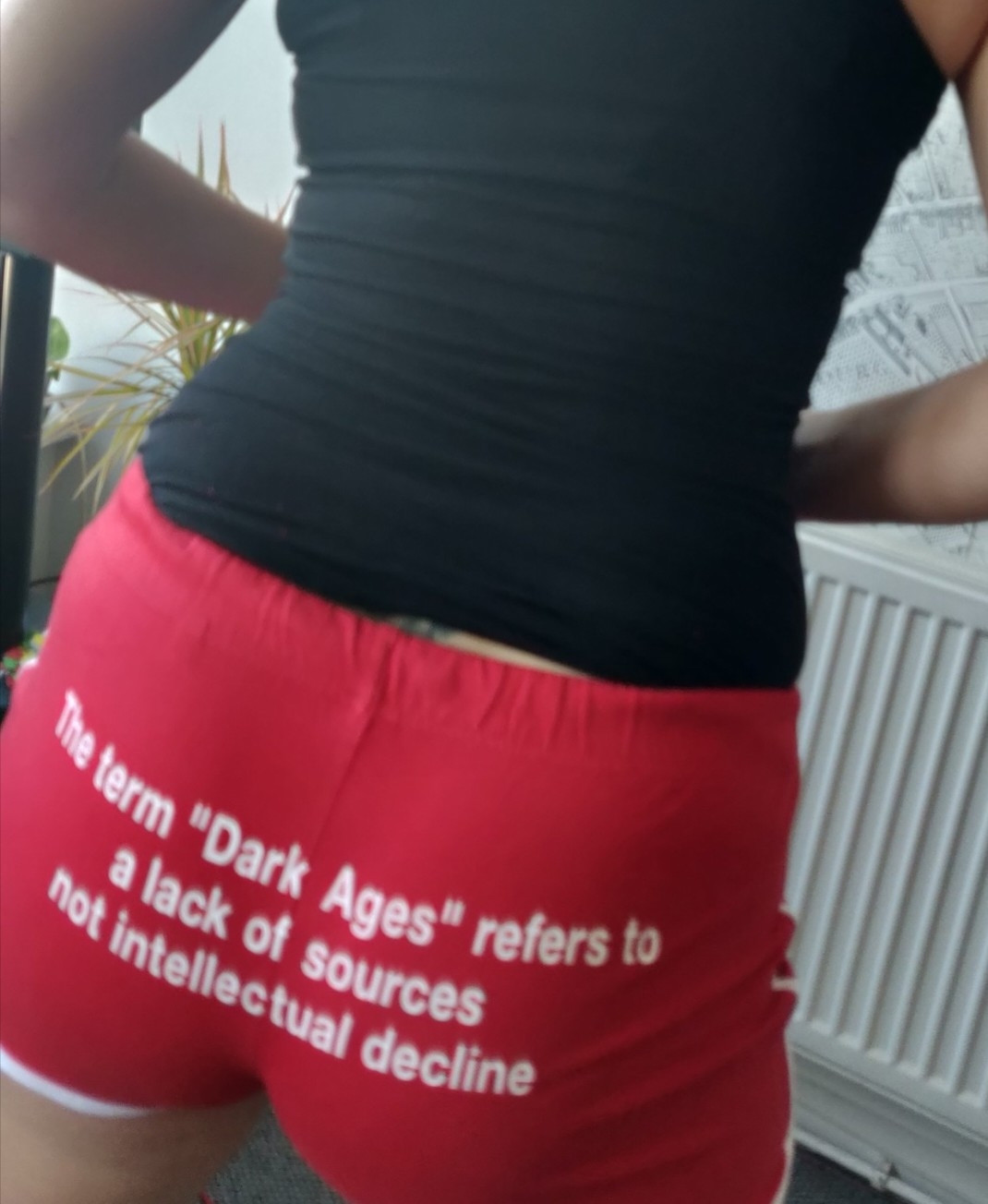
Unfortunately, though I have made the world’s best booty shorts and deployed them with great skill and aplomb, there are still those in our society who refuse to heed my message, and also to learn basic history.

This fact was brought to my attention once again this past month when a terrible take floated across my serene feed over at bsky.app (which, incidentally is the place you are most likely to find your girl posting of late). In this case the terrible history in question was this:

Read more: On contrarian history
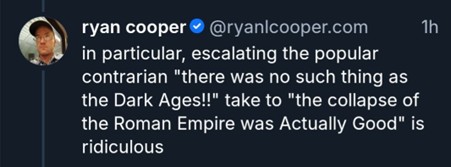
Fun fact: this man then blocked me when I made fun of him for being woefully ignorant on the subject and suggesting he should probably not try to opine on things when he hasn’t done the reading. Because of course he did.

Of course, I know you are not an ignorant blowhard, and indeed, because you are here, I assume I hardly need to relitigate the fact that the term Dark Ages does not refer to a period of intellectual or cultural decline. You are all aware that it simply refers to a time of limited source survival. And you all also understand source survival and how it works.

What is interesting to me here in this take, other than the continued and wilful ignorance of individuals who wish to see themselves as better than medieval people, is that this view is only possible if we don’t consider the material conditions of average people.

Because of how source survival works, or indeed, how architectural survival works, we are often encouraged to think of the past as a place populated entirely by the wealthy elite. After all, it is the wealthy elite who write the majority of historical sources, in that they are often the only people trained to be literate. This is by design in order to create an elite population, of course. This tactic will persist into the modern era with, for example, forced illiteracy on enslaved populations.[1]
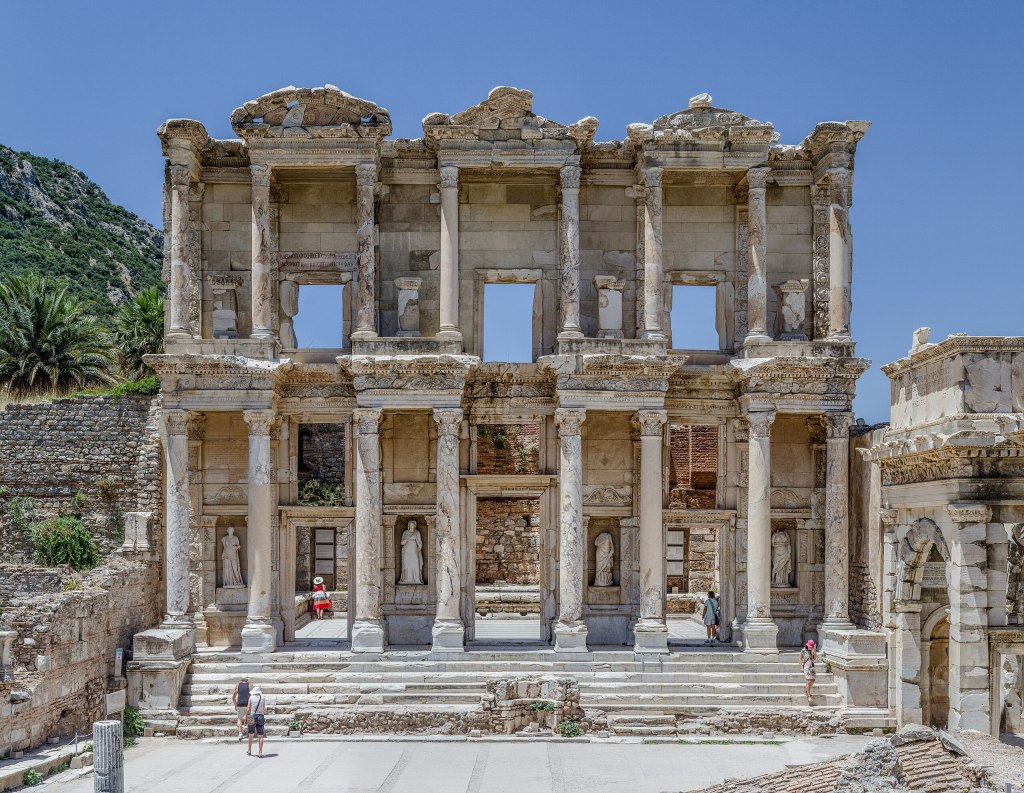
The facade of the Library of Celsus, comissioned c. 110 CE by the counsul Tiberius Julius Aquila Polemaeanus, to commemorate his father Tiberius Julius Celsus Polemaeanus, the former procounsul of Asia. That is who has libraries and tells you exactly why they build them.

Further, it is elites who have the ability to preserve documents. You need libraries to keep documents safe, and those are expensive and difficult to keep from burning down.  The sort of person who has that kind of ready cash will ensure that the documents preserved are those which show them and their ancestors in the best possible light, and which reinforce their own cultural and economic control of the society. So you mainly just hear about rich people and what they owned as well as a lot of justifications for why you can’t be mad at them for resource hoarding. It’s quite dull.

If we are thinking about buildings, the same is also true with some added factors. Most ordinary people’s houses, especially in Europe, were made out of organic materials. There’s rather a lot of building with wood and/or wattle and daub going on. This cannot survive for millennia. What can survive is things that were made out of stone. This privileges the survival of things like monumental architecture (such as the colosseum in Rome, for example), or religious architecture (temples, churches, and cathedrals) and the homes of the wealthy. From a Roman standpoint the homes of the wealthy are, for example, villae.

Much is made of said villae. ‘Romans had underfloor heating! Roman houses were decorated with beautiful mosaics!; Now, technically both of those statements are true – but you need to ask yourself which Romans enjoyed those things, and how it was that they managed to do so. The answer is a violent, crushing, and brutal slave empire.
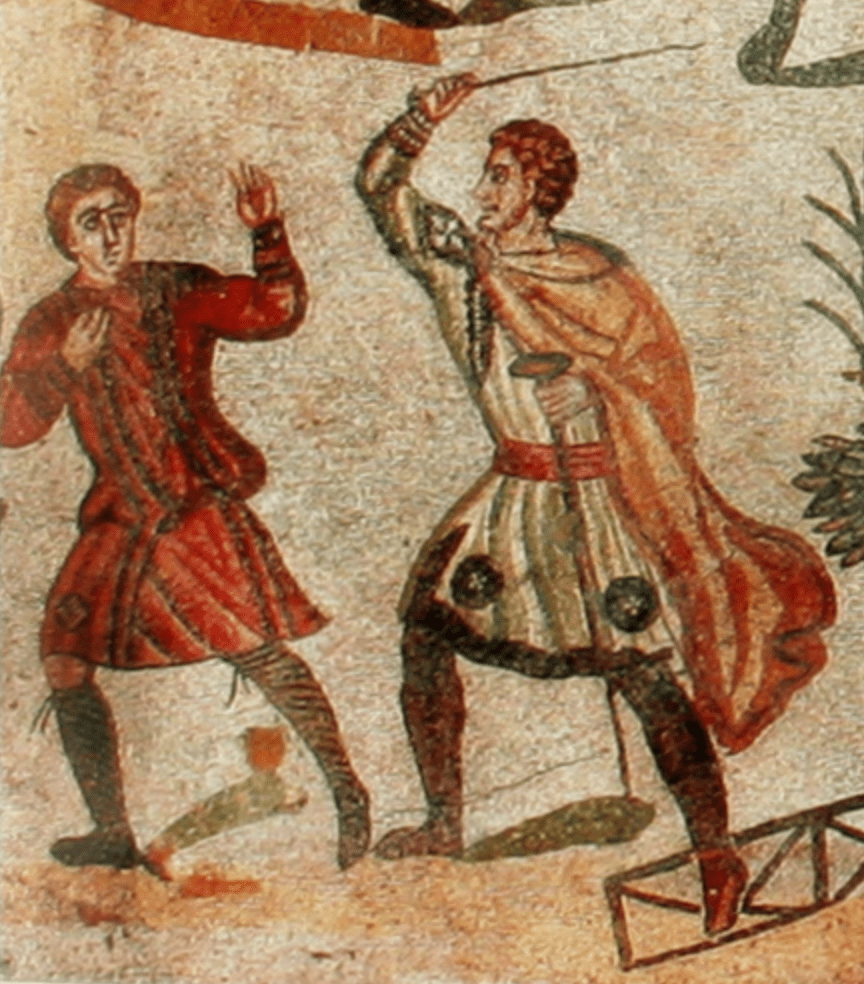
A mosaic of an enslaved person being beated, from the Villa Romana del Casale, Sicily. Heow hartwarming.

Every Roman villa where we find the owners enjoyed underfloor heating was actually kept warm by the enslaved people keeping the system’s fires going. Sometimes, the beautiful mosaics include images of enslaved people being beaten. The lavish lifestyles that the people inside enjoyed were made possible by brutally controlling the local population of wherever they had reached, and forcibly taking their goods and sometimes just the people themselves. But we don’t get to hear from the people doing all the actual work around here very often, because of their position in society.

And lest anyone attempt to convince you that all of those workers were just happy to be part of the giant violent slave empire, I very much encourage such parties to read the excellent Strike: Labor, Unions, and Resistance in the Roman Empire by Sarah E. Bond, which is full of examples where workers attempted to band together to argue for better conditions and pay. These are not the actions of people who are happy with their lot.


If you are enjoying this post, why not support the blog by subscribing to the Patreon, from as little as  £ 1 per month? It keeps the blog going, and you also get extra content. If not, that is chill too.


Further, anyone who would argue that actually it’s great being enslaved is encourage to consider if it would be great for them personally. Because here is the thing – if you go back in time to the Roman Empire you are not going to be a senator. You will be a peasant. Further, if you went back in time to say, Pergamon in the first century CE, then according to Galen (c. 129 – c. 216), there’s about a twenty-five percent chance that you would be enslaved.[2] If we keep in mind that in general we think enslaved populations decline in the late antique period, depending on when and where you are born, some estimates about enslaved people in the Roman Empire go as high as forty percent of the population being enslaved. I, personally, do not believe that is good, cute, or worth it so that twelve guys can have really cool mosaics in their dining rooms.
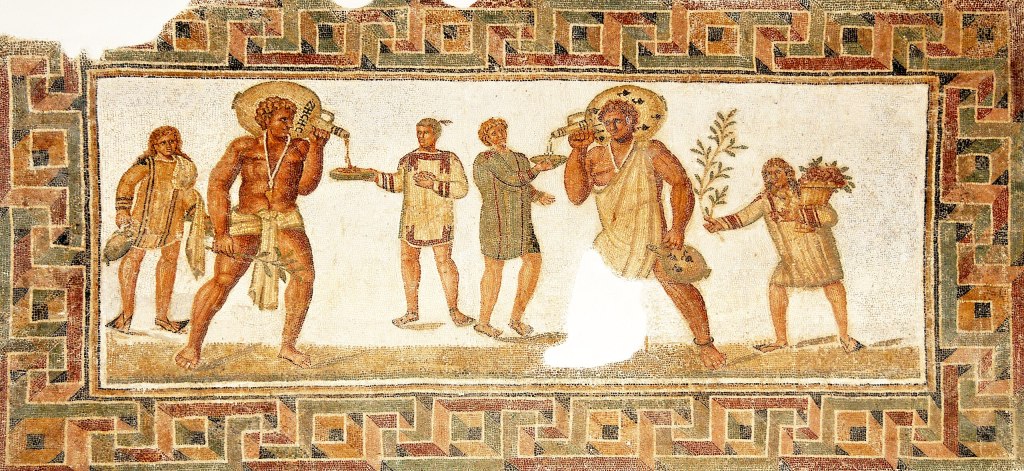
Enslaved people serving wine and carrying towels, from Douga, Tunisia.

To be fair to Romans (though why I should be is anyone’s guess) there are some good things that Roman rule provided via taxes – roads, for example. And sure, Roman cities did indeed look pretty cool, and I am pro-city as a general rule. However some of the things that your taxes would pay for – like ampitheatres – are just bad. I do not think it is cool to make enslaved people fight each other to the death. I do not think you should import exotic animals and then slaughter them before a crowd.

Again, those who would defend these practices are encouraged to consider whether they would volunteer to be a prisoner of war ritualistically slaughtered before a crowd, or whether they think of themselves as the Emperor enjoying the spectacle. I think it is important to think about which scenario is more likely.

At any rate, all of this – the spectacle of conspicuous consumption, the violent games – is neither here nor there when we begin to speak of the collapse of the Western Roman Empire and the transformation of Europe in the early medieval period. Because here is the thing – yes I do think that it is good and also cool when slave empires collapse. Because then they can’t do wholesale enslavement. That’s one thing.

The other reason it is good? Because the collapse of said Empire doesn’t actually mean that there is a collapse in industry, and in fact is usually linked to increased life expectancy in local communities.
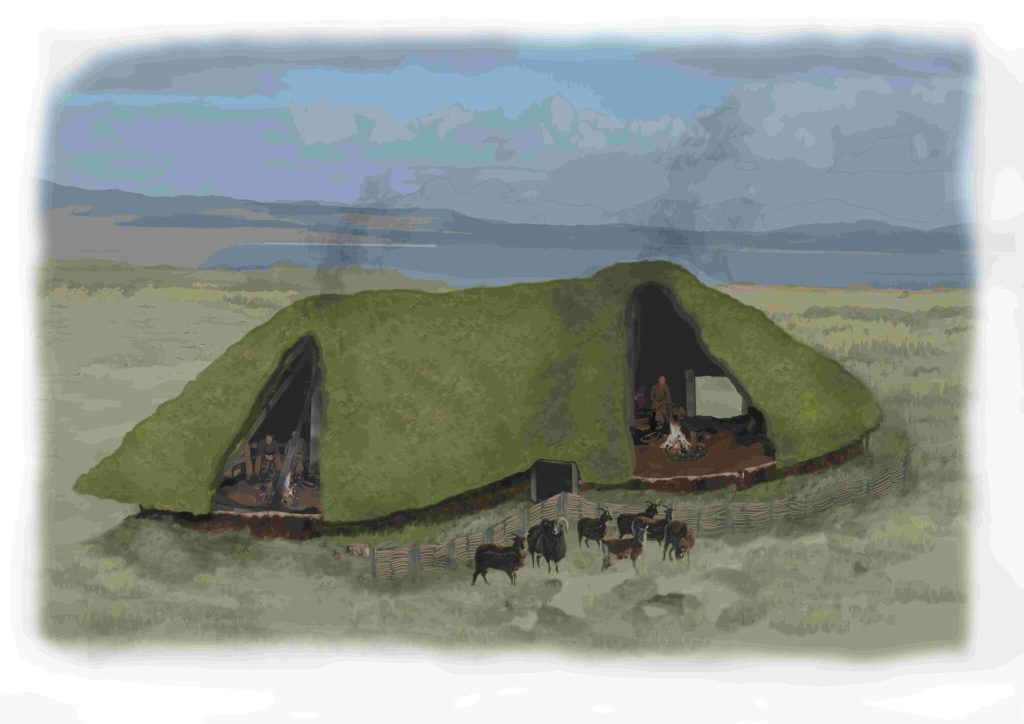
A reconstruction of an early medieval metal workshop on the island of Islay. You can read more about this very cool archeological find, here.

Case in point – post-Roman Britain. There has been some really interesting archaeological research in this area of late, and one thing they have found is that after the Romans fuck back off to the continent, things like metal production actually increase in volume. Yes there was an eventual crash in that production in the sixth century, but that happens because everyone got the Justinian plague.[3] Even if you like Empires because you are a weird sicko, I am afraid you have to admit that they do not, in fact, somehow curtail the spread of plague in a world without germ theory and antibiotics. The Roman Empire, therefore, is actually not necessary for keeping industry going.

Further, analysis of the skeletons of people in Britain after the Romans left shows us that their health improved quite a bit. As a general rule this is seen as consistent with a more balanced diet and increased calorie intake. Over time this leads to an increase in height as well as a longer life span.[4]

Considering these factors – who is eating what, what is being made, who is consuming it – is at the heart of understanding history. You will never be able to convince me that the society that starved a native population so a couple of rich guys could have a fancy house and go watch prisoners of war be killed for sport is better than the one that sees the average person become healthier and live a longer life. I do not care if those rich people were enjoying goods imported to the region from North Africa. Those rich people were a vanishingly rare segment of the population and their consumption patterns were only made possible through horrible crushing violence perpetuated on average people.

And here’s the thing, that is not ‘contrarian’ that is called ‘historical analysis’ which is done by ‘historians’ when we do things like ‘analyse primary sources’ and archaeologists when they ‘dig up bones’. That is what we do. That is the work. Further, the fact that there is no such thing as a ‘Dark Ages’ and that a term we used for source survival has escaped containment and been rendered meaningless by a bunch of poorly read self-congratulatory dolts is, in fact, what we call ‘settled academic fact’. This isn’t a debate! That is literally what is true!
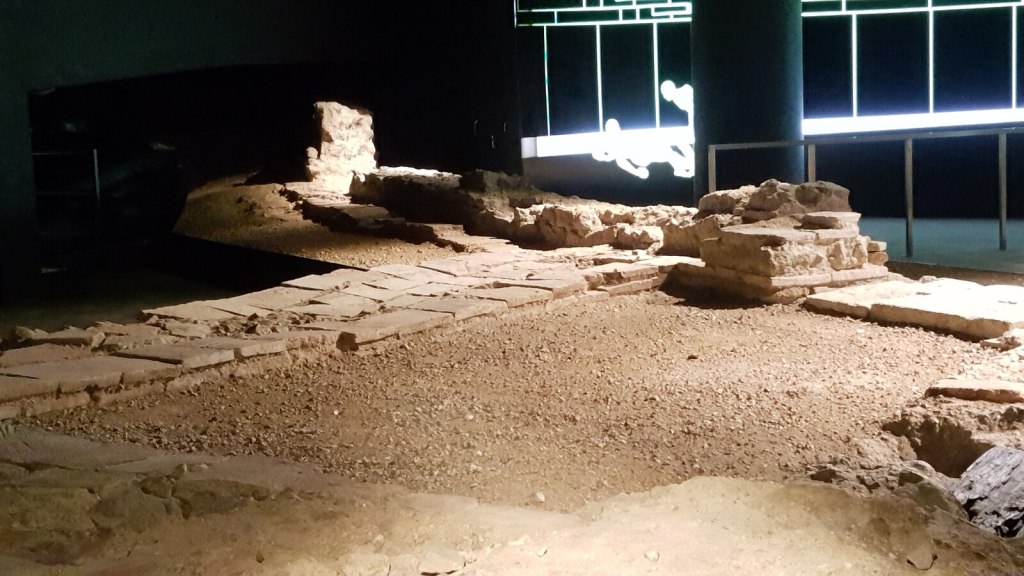
A section of wall from the Roman ampitheatre in London, now under Guildhall. It’s grim.

Of course, there is at the heart of this sad man’s idiotic rant the standard irony: he is arguing that the ‘Fall of Rome’ crated a ‘Dark Ages’ which was bad and is a term that is pejorative from a place of total ignorance. This man has never read an actual history book. He knows nothing about the early medieval period. If I asked him to describe the system of governance in Visigothic Iberia, for example, he is unlikely to even understand what I am asking. Yet he has a deeply held opinion on this era which he chooses to put about online. And he will block medieval historians such as myself if we take offence to his positioning us as contrarian.

It is contrarian to argue in defence of a system which steals from workers to give to a vanishingly small segment of a wealthy population. It is contrarian to refuse to learn about a subject and still think your opinions on it are valid. It is contrarian to ignore experts when they correct your profound and deep-seated misunderstanding.

However this man, and the legions of those who will go to bat for a violent and oppressive Empire, do not see themselves as contrarian because they are not engaging with actual history, they are engaging with a hegemonic historiography. They believe in the glory of the Roman Empire and its inherent good because they themselves currently live inside a violent empire that exists to funnel money to a wealthy elite. If you begin to question whether Rome was bad for the average person – if you start to ask why there was money for some people to have underfloor heating, while there wasn’t enough to adequately feed the population of Brittania – you may start asking questions about what is happening around you.

There is no such thing as revisionist history. Writing history is a constant process of re-evaluation of sources and attempts to control for the biases of the past as well as our own. Anyone who calls the people doing that work contrarian, or accuses them of attempting to ‘rewrite history’, fundamentally doesn’t understand what history is and what it does. Or perhaps they do, and they want to prevent historians from questioning the world around us. So, take your pick: are you ignorant, or just a bad person? I can’t answer that for you.


[1] Cornelius, Janet. ‘”We Slipped and Learned to Read:” Slave Accounts of the Literacy Process, 1830-1865’, Phylon (1960-) 44, no. 3 (1983): 171–86. https://doi.org/10.2307/274930.
[2] Ramsay MacMullen, ‘Late Roman Slavery’, Historia: Zeitschrift Für Alte Geschichte, vol. 36, no. 3, 1987, pp. 365.
[3] CP Loveluck, MJ Millett, S Chenery, et al., ‘Aldboroughand the metals economy of northern England, c. AD 345–1700: a new post-Roman narrative’, Antiquity. 2025;99(407):1320-1340. doi:10.15184/aqy.2025.10175
[4] Alvaro Luis Arce¸ Health in Southern and Eastern England: A Perspective on the Early Medieval Period, PhD Thesis, University of Durham, 2007. https://etheses.dur.ac.uk/2595/ <Accessed 24 November 2025>


For more on myths about the medieval period and empire, see:

There’s not such thing as the Dark Ages, but OK
I wasn’t taught medieval history so it isn’t important is not a real argument, but OK
On successor states and websites
On colonialism, imperialism, and ignoring medieval history


Support the blog by subscribing to the Patreon, from as little as  £ 1 per month! It’s the cool thing to do!

My book, The Once And Future Sex: Going Medieval on Women’s Roles in Society, is out now.


© Eleanor Janega, 2025
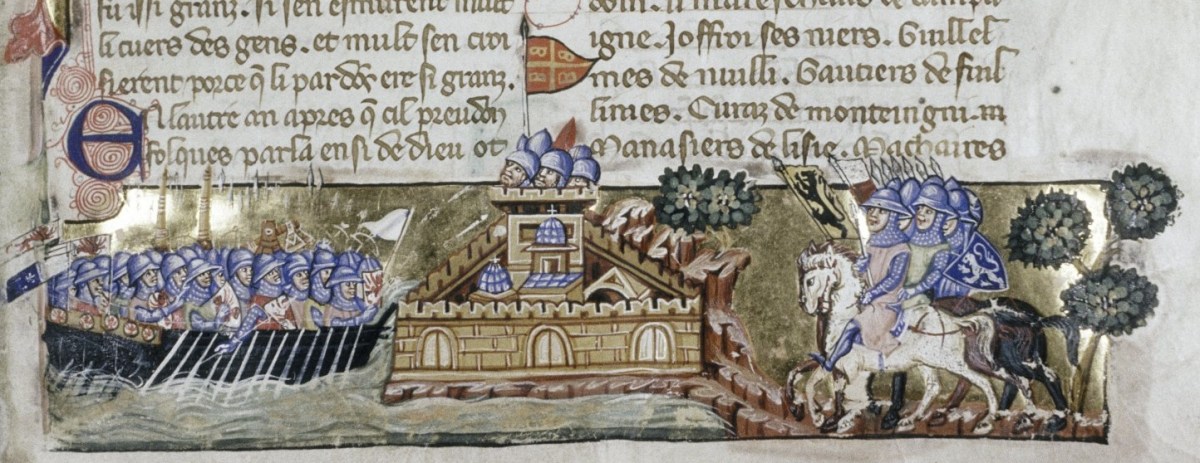
On Crusades, or, how not to identify with losers

I think about Crusades a lot because that’s my job. I also think about them a lot because, well, there were a lot of them – which is pretty wild when you consider they didn’t exist as a phenomenon until the high medieval period and yet they still managed to do way too many of them.

Read more: On Crusades, or, how not to identify with losers

Why did it take so long to come up with the concept of a Crusade? I mean, in a mostly Christian society largely led by dudes on horses with big sticks, why didn’t anyone try this stuff on sooner? Well as I will never tire of telling you, for quite a few centuries the papacy didn’t actually have very much power. For a great part of the early medieval period, popes were busy hanging out in various graveyards in Rome arguing with the other guys who claimed they were pope too, and occasionally getting beaten up in the streets. But they were a plucky bunch, and one of the things they managed to do over time is write a bunch of books about how fancy and important they were. This helped them to slowly consolidate power, so by the time you hit the eleventh century they were actually pretty influential people.

A good way to think about the medieval Church is as a sort of legal structure and series of courts that also has some services attached on the front. So in a lot of ways they acted something like a state does now. They took tithes, which were like taxes, and in theory made sure that in return the basic pastoral care needs were met. They also were involved in high level politics across Christendom – weighing in on controversies, advising kings and emperors, and basically making big calls.

So they are … kinda like rulers? I mean they do rule a complex state apparatus? And one of the things that people who rule do, often to the detriment of society as a whole, is they engage in warfare. So when the Church reached the dizzying heights of medieval power they almost immediately began to call for war. Like, a lot.

Pope Urban II at the Council of Clermont about to call a crusade, from the fifteenth-century Passages d’outremer , BnF Gallica MS Fr5594, fol. 19r.

When we use the term ‘Crusade’ most people are going to think about Europeans venturing to the Holy Land, and that’s fair enough because that’s exactly what the first Crusade was. But there are so so many Crusades to look at across the medieval period. You can choose the first, second, third, fourth, fifth, and sixth crusades to the Levant or Asia Minor, obviously. But also there’s the Albigensian Crusade against the various good men and women in Languedoc.[1] Or how about the Crusades against the non-Christians in the Baltic region, prosecuted more specifically by the Teutonic Order, who were invented just for this purpose?[2] As a Bohemia specialist, I, of course, spend a bunch of time thinking about the Crusades called against the Hussites.[3]

That’s so many Crusades to think about, against so many groups of people, and across centuries on centuries. So when we say ‘Crusades’ is there any way to really think about any of these groups as a contiguous whole? I would say yes, because pretty uniformly every single one of these Crusades were fought by a baffling assortment of losers who were totally ineffectual.

What do I mean by that? Well, exactly what I said, thanks. It’s not really ambiguous.

But for some reason people have largely managed to ignore the fact that all of these Crusades were absolute miserable flops that didn’t manage to do a whole lot more than get a bunch of random people killed.

A massacre of Jewish people from Royal Belgium Library MS 13076-13077 fol 12 v. This is from a fourteenth-century massacre because people recording the First Crusade didn’t want to dwell on, you know, all the murder of their fellow people.

Take the First Crusade, for example. It was called because the good people in Eastern Rome had lost a lot of land what with the sudden incursion of Seljuks to the Levant. Constantinople were unhappy about this because they had lost a lot of taxable land, and so they came up with the smart idea to go talk the Christians out west into helping them out. The Seljuk take-over had disrupted ordinary pilgrimage routes and so the Greeks figured that the Westerners might help because they would want to make sure they can visit Jerusalem again. Constantinople were right on that one, and all of a sudden people began flooding East.[4] Trouble is a lot of them were, in the opinions of Eastern Rome the wrong sort of people. These were the ordinary individuals who got riled up by preaching of individuals like Peter the Hermit (c. 1050 – 1118 or 1131) and figured that they wouldn’t mind fighting a holy war. Trouble with them is the main thing they did was kill a bunch of Europe’s Jewish population on the way East, starve, and then immediately get massacred the minute Constantinople pushed them over to Asia Minor and into enemy territory.

Now you can make an argument that the actual knights – a vanishingly small segment of the European population – who went on the first crusade were ‘successful’ but like, IDK most of them mostly died of dysentery in a ditch in Syria. They sort of trip over their dicks and manage to get hold of Jerusalem, but a lot of them had got bored by that point anyway and set up shop in Edessa and refused to go any further. From the standpoint of Constantinople who asked for all of this, the entire thing was a failure because mostly just some Norman guys were living over there now. And yes, some new kingdoms and counties etc were set up, but if the Crusade was so fucking successful why doesn’t everyone in Jerusalem speak Norman French now? Why did a second Crusade need to be called? Because they were terrible at actually running kingdoms in the Middle East, that’s fucking why.

The Second Crusade meanwhile was a total disaster that mostly just managed to break up the marriage of the king and queen of France.[5] Great job everyone. The Third Crusade?[6] Got Frederick Barbarossa (1122-1190) drowned in a river. Fourth Crusade?[7] It sacked Constantinople, the theoretical bastion of Christendom in the East. The Fifth Crusade?[8] Basically, just the sad trombone noise being played at Crusaders in Egypt. The Sixth Crusade?[9] Basically a wedding and a holiday that Frederick II (1194-1250) didn’t really want to go on. So yeah, just a series of losing endeavours that were necessary because the First Crusade was also a losing endeavour and nobody knew what they were doing.

The Siege of Damascus in the Second Crusade, a total Crusader defeat. From the fifteenth-century Passages d’outremer , BnF Gallica MS Fr5594.

So yeah some people were pretty willing to admit that maybe this whole Crusades in the Holy Land thing was pretty stupid. But the idea of holy war was out of the bag now and a lot of people were getting into it. I mean, why go all the way to the East when you could just fight some non-Christians at home and maybe take some land that you had hope of actually keeping? This led to the call for the Northern Crusades in 1195 where Pope Celestine III (c. 1105-1198) felt that there were far too many of what he called ‘pagans’ up in Northern Europe and thought he would send in some Germans to do something about it. This led to the rise of the afore-mentioned Teutonic Knights who did a good line in building brick castles and occupying territory, but a worse job of actually making locals really love Christianity.[10] As a result the Northern Crusades dragged on until the fifteenth century when eventually the last non-Christians were converted officially because of some political marriages. Not exactly an advertisement for the enduring power and usefulness of Christian violence.


If you are enjoying this post, why not support the blog by subscribing to the Patreon, from as little as  £ 1 per month? It keeps the blog going, and you also get extra content. If not, that is chill too.


To be fair, by this time there had been one ‘successful’ Crusade though – the thirteenth-century’s Albigensian Crusade. Here the French crown noticed that down in Languedoc a lot of people were kinda frustrated with what they considered the worldliness of the Church and had a new DIY kind of Christianity going on. They also weren’t French. They spoke Occitan, and were generally vassals of the Angevin Empire. The French crown didn’t love that, but also didn’t feel like declaring war on England so they cooked up an excuse against the Good Men and Women of Languedoc who they called the Cathars and absolutely massacred a group of Christians and stole their land. Yay? Great stuff. Not at all gross. But I guess you can call it a success if you are a weird freak.

The expulsion of the so-called Cathars from Carcassonne, you know, a nice thing that definitely wasn’t about money, power, or a brutalisation of other Christians. British Library Cotton MS Nero E II Grandes Chroniques de France, f 20 v. Fifteenth century.

This would be a high point for Crusades in Europe though, as the next big one to get called was the Crusades against the Hussites, my favourite little guys. I hardly need to tell you again, that all five (count ‘em five) of them were huge disasters. Hussites 4 Life.  Žižka ‘til I die. Etc etc.

There’s plenty more minor Crusades where this came from, whether it was against peasants who had the temerity to think of themselves as people, or Bosnians who had their own sorts of Christianity, or just, you know Alexandria. Again, most of these failed, although yeah I guess the Church sure did show those peasants in Stedinger. Eventually. After first being defeated.

So yeah, the major thing that the Crusades were good at doing was getting a bunch of random rich dudes to go die somewhere other than their own bed, and for that I guess I have to like them. However, if we are relating to them as some form of romantic or successful enterprises then it’s just a bit off.

Seriously pals, this is very good.

This is something I have been thinking about a lot more recently, because I have just finished doing a big (11 part!) series on the First Crusade, Welcome to the Crusades, alongside my intrepid We’re Not So Different co-host Luke, and with the good gentlemen of American Prestige. The thing that really sticks out when you spend a lot of time mired in the granular details, especially when you are working with a specialist in Islamic history, is just how silly and ultimately wasteful a lot of this stuff is. Like yeah, I love a good story of about a fake Holy Lance, and how the person who claimed it was real ended up dying of burns after being burnt severely during a trial by fire. Yes. It’s amusing. However, maybe, just maybe it would have been a better use of time and life if …. Peter Bartholomew (d. 1099) just didn’t… do… that. It would be better if everyone who died in the Civetot massacre just stayed home. And you know, I bet you anything that Emperor Alexios I Komnenos wished he had never invited Europe’s foremost landless failsons East, thereby weakening the Eastern Roman Empire further, and never actually getting any of his lands back in the bargain. It’s all just so stupid.

So why have I told you all of this? Or spent my precious hours on this beautiful planet thinking about these fools and their follies. Well, we’re in a strange time when people are really desperate to tell stories about where we came from, and the greatness we can call upon in times of need. This has led some people to think wistfully about crusaders and how they were big burly knights who had great bulging biceps and did manly things with swords, and to begin to pretend that they – some guy in Missouri – is like them. ALSO they are not thinking about it in a gay way. They swear. And like, I get it, things are really horrible right now and everyone wants some escapism.  But, uh, if what you want to pretend in this hour of darkness is that you are a Crusader then I have to wonder why even in your wildest imagination you are still a weird loser.  

You know if I was gonna pretend to be someone cool from the medieval past it would be like … huh … I was gonna say Frederick II, who technically went on Crusade and hated it the whole time because he thought it was a stupid waste of time when he wanted to be taking long baths with his several many side pieces. Legends only. Yeah feel free to pretend to be him. Take up hawking or something. IDK.

It’s not that it isn’t fun to think about crusaders. Clearly I spend a bunch of time doing that. It’s that it’s fun to think about them because it’s actually hilarious to watch rich boys fail and get sad, not because Crusaders are cool or useful or good at anything. The more you know about the medieval world the less you fall for the weird stories people tell about it. So I very much invite you to join the medievalist team, learn more about the Crusades, and stop romanticising losers.


You can check out all 11 (!) episodes of Welcome to the Crusades now. It’s really good.

[1] A great book on the Albigensian Crusade is Mark Gregory Pegg, A Most Holy War: The Albigensian Crusade and the Battle for Christendom, (Oxford and New York: Oxford University Press, 2008).
[2] On the Northern Crusades try Alan V. Murray, Crusade and Conversion on the Baltic Frontier 1150-1500, (London and New York: Routledge, 2017).
[3] On the Hussites I like Howard Kaminsky, A History of the Hussite Revolution, (Eugene, OR: Wipf & Stock Publishers, 2004).
[4] A really interesting book about who went on Crusade is Conor Kostick, The social structure of the First Crusade, (Boston: Brill, 2008).
[5] On the Second Crusade and why it sucks, check out David Nicolle, The Second Crusade 1148: Disaster Outside Damascus, (London: Bloomsbury USA, 2009).
[6] A longer list of everyone who went over to fail in the Holy Land can be found in, Stephen Bennett,  Elite Participation in the Third Crusade, (London: Boydell Press, 2021).
[7] Jonathan P. Phillips, The Fourth Crusade and the Sack of Constantinople,  (London: Pimlico, 2005).
[8] The Fifth Crusade sucked so much that no one ever writes about it, but a good volume is Joseph P. Donovan, Pelagius and the Fifth Crusade, (Philadelphia: University of Pennsylvania Press, Incorporated, 2016).
[9] Again, not a lot of Sixth Crusade literature, but the interesting stuff is Frederick II anyway. Check out Richard D. Bressler, Frederick II: The Wonder of the World, (Yardley, PA: Westholme, 2010).
[10] If you are interested in the Teutonic order I recommend David Nicolle, Teutonic Knight: 1190–1561, (London: Bloomsbury, 2007).


For more on not romanticising the past, see:

You are not, in fact, the granddaughter of the witches they couldn’t burn
On what we choose to remember


Support the blog by subscribing to the Patreon, from as little as  £ 1 per month! It’s the cool thing to do!

My book, The Once And Future Sex: Going Medieval on Women’s Roles in Society, is out now.


© Eleanor Janega, 2025

On what Americans know about medieval history

Being a medieval historian is weird, in general. I spend a lot of time reading and thinking about a thousand years of history which is largely ignored. When I do manage to then attempt to share my love (or obsession, if you want to be a dick about it) I am often met very specifically with pushback from people who have a deeply held, preconceived idea of the medieval period as ‘violent, dark, and dirty.’ Admittedly my experience could be anecdata. Maybe there is something about being so so cute and fun that makes haters flock to me, specifically, to say incorrect things. However, luckily for me I had a chance to actually look at some honest to god data about this, thanks to the hard work of David Montgomery, Senior Data Journalist at yougov, who blessedly took the time to poll a bunch of Americans to see what they thought about the best millennium. In my opinion these results say a lot about society, so we’re gonna look at them today.

Read more: On what Americans know about medieval history

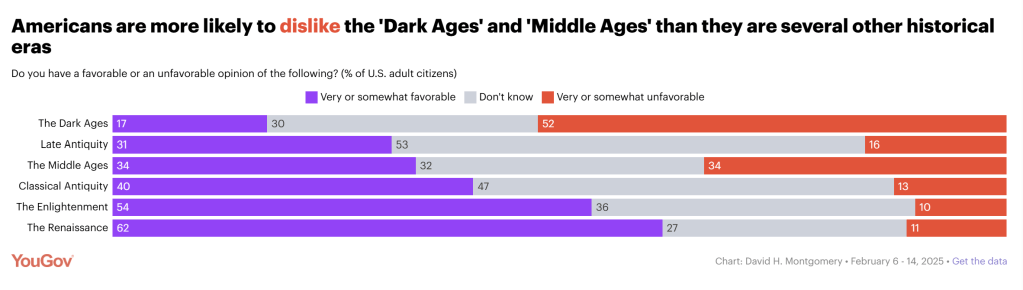
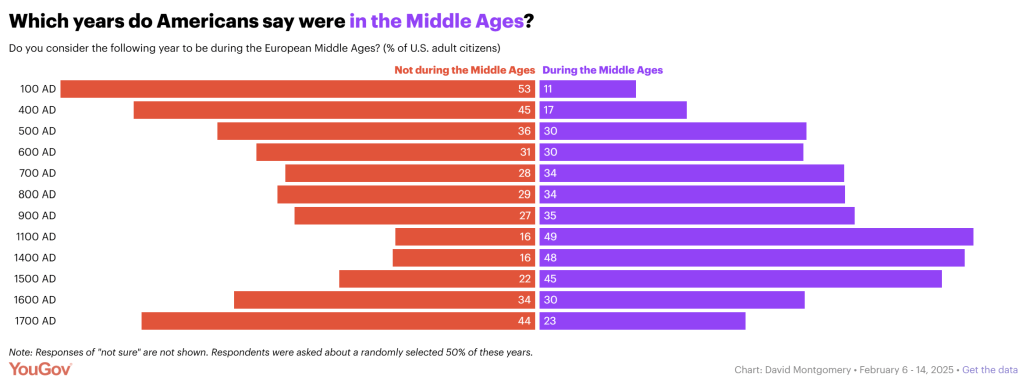
So let’s start off with the first poll. Now I am not a huge fan of attempting to demarcate the so-called Dark Ages, or early Middle Ages, from the rest of the Middle Ages, but overall this is instructive. I … am not unhappy with the number of people who view the Middle Ages positively? Thirty-four percent is pretty good, given the amount of bad press we are constantly having to work against. What is not good is that an equal number of people still have an unfavourable opinion of the medieval period. Even worse, the poor Dark Ages are languishing at only seventeen-percent favourability, with fifty-two percent of people being ignorant weirdos about it. I know I go on about this all the time, but it is hugely ironic that a bunch pf people who literally don’t know anything about the Early Middle Ages therefore blame that period for their own laziness. Like yeah man, those were the stupid people. Not you, the person who probably couldn’t even point to the period on a timeline.

It’s also interesting to see how influence propaganda has on these opinions. We have a sixty-two percent favourability rating for the god-damned Renaissance. The irony here is I am almost certain that if I asked these Renaissance lovers why they liked it so much they would say something about emerging from the superstition, bigotry, and ignorance of the medieval period. Like yeah man, I simply love the period when *checks notes* persecution of gay people increases, life expectancy decreases, Europe experiences the witch trials, and the Church goes full Borgia Pope. What’s your favourite thing about the Renaissance? The advent of syphilis? Or the violent subjugation and colonisation of the Americas? It’s so hard to pick because it’s just a really beautiful time to be alive, you know?[1]

But that doesn’t matter, because the Renaissance has great PR. When you are taught about it in American schools, everyone just gushes about Michelangelo and the Medici’s great art collection. They gloss over the fact that most people aren’t rich assholes who get to look at and collect said art. Contrast this with the medieval period, which we are just not taught about, and you can see where the problem lies.

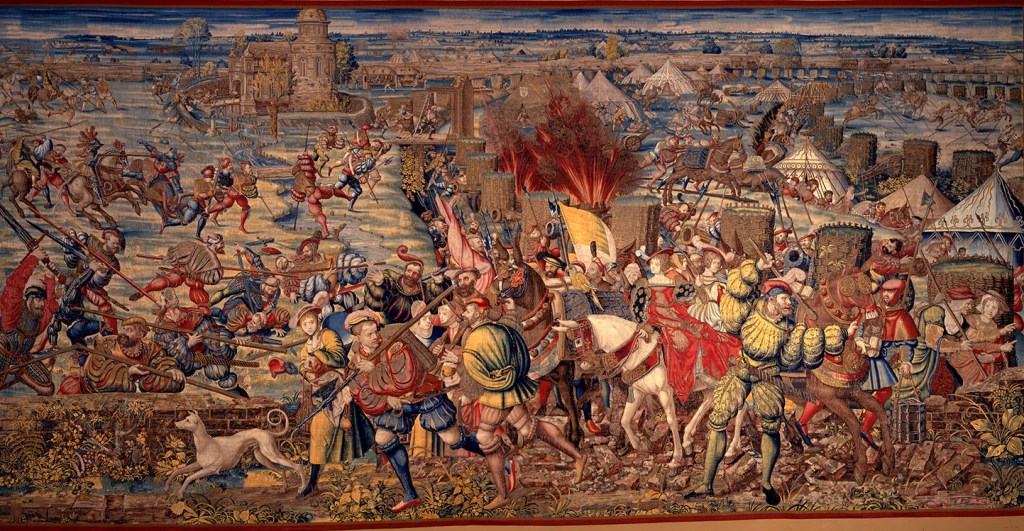
One of the images from the Battle of Pavia tapestry, which depicts the very peaceful and reasonable time everyone was having during the Renaissance.

More specifically however, there is a unique dislike of the medieval period beyond just generalised ignorance. Contrast the Middle Ages and Dark Ages with Late Antiquity here and we get an interesting phenomenon – people don’t know much about Late Antiquity, so they just say ‘I don’t know’. But everyone has an opinion on the Middle Ages, which is completely unwarranted. I am blaming  Voltaire for this, obviously.

So, overall, I think we see here a slightly better attitude to the Middle Ages than expected, but yo, it hurts to get beat by Classical Antiquity. A period that people also don’t know about but still believe the hype on.

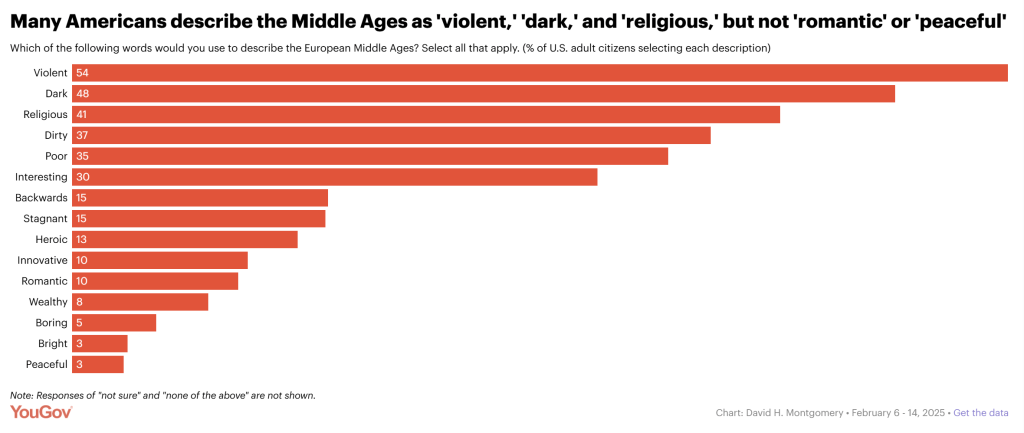
The second poll just makes my feelings on this worse. Why don’t people like the Middle Ages? Well, because it was, according to them, ‘violent, dark, religious, dirty, and poor’. And like, my brothers in Christ – how is this different from the Renaissance, which you were just telling me you wanted to jack off? I am not here to tell you that the medieval period is a specifically peaceful time, but it pales in comparison to what goes down in the early modern period, in which both the apparently beloved Renaissance and Enlightenment periods lie.

During the early modern period wars become larger and weapons more deadly, and attendant death rates go up. So how is that also not … dark? As for ‘religious’, um, uh, um have you met the early modern period? That is the most violently religious time period for Europeans! The thirty years war? The witch panics? Using religion as a justification for violent settler colonialism and chattel slavery? Modern things! Being done most modernly! I am not here to tell you the medieval period wasn’t religious – it absolutely was. But my point is that if you are gonna call it religious and respond to that negatively, then you also need to be mad at literally every other time period in this poll and you aren’t. So there is a specific bias here.

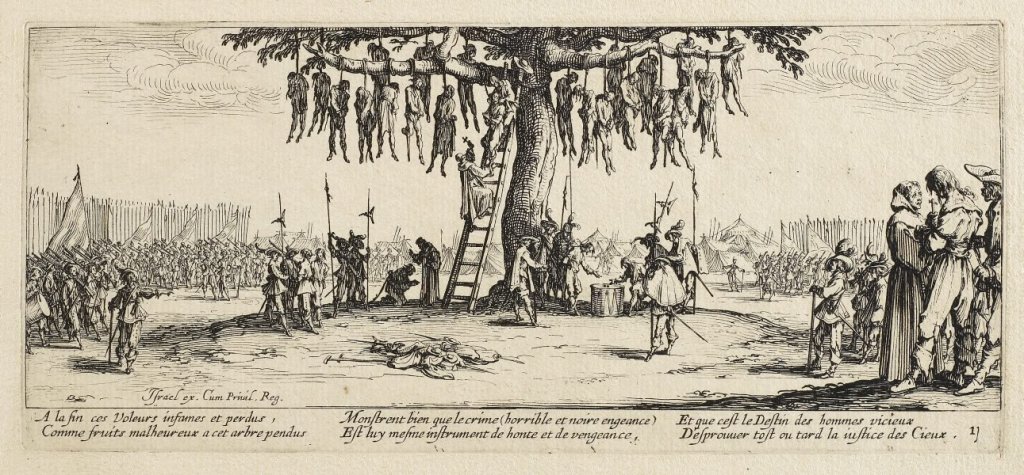
Jacques Callot’s ‘The hanging of 1633, or, the miseries and unhappy fruit of the war’, which depicts a mass hanging near the end of the thirty-years war.

As for the ‘dirty’ thing? Medieval people bathed. Medieval people bathed. OH MY GOD MEDIEVAL PEOPLE BATHED I AM SO TIRED OF YOU PEOPLE.

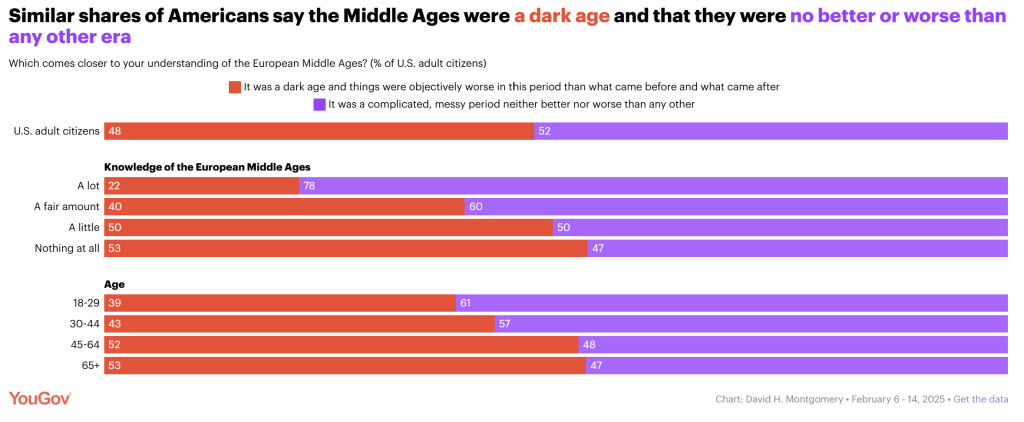
To be fair, it’s not all bad, and Montgomery notes that when ‘[a]sked to choose between two views of the Middle Ages — neither of them particularly positive — 48% of Americans say “it was a dark age and things were objectively worse in this period than what came before and what came after,” while 52% say “it was a complicated, messy period neither better nor worse than any other.”

Younger Americans and those who say they know more about the Middle Ages were more likely to say it was neither better nor worse than any other period, while older Americans and those who know less about the Middle Ages were more likely to call them a dark age.’[2]

So, the young people are absolutely coming to bat for the medieval period, and frankly, I love to see it. This gives me some personal hope because apparently people are listening to us when we write histories and Americans are improving as a cohort as a result. I am gonna try not to focus on how older people do run their mouths about things they don’t know and take the very small w. Thanks very much.

Clearly as well we see that the more people know about the medieval period, the more likely they are to be correct about it. I do find it interesting that people who admit that they only know ‘a little’ about it, immediately slam their hands down on the ‘negative’ button, with (surprise!) the biggest cohort of haters knowing ‘nothing at all’. How – how I ask you – do you blithely admit you don’t know what you are talking about, and then announce that a thousand year period is bad? Pretty easily apparently, but still!

I would challenge this forty percent of people who claim they ‘know a fair amount’ about the medieval period and say it’s a bad time, however. Like babe, is that the medieval period, or are you just blaming medieval period for the early modern period again? There are many such cases!

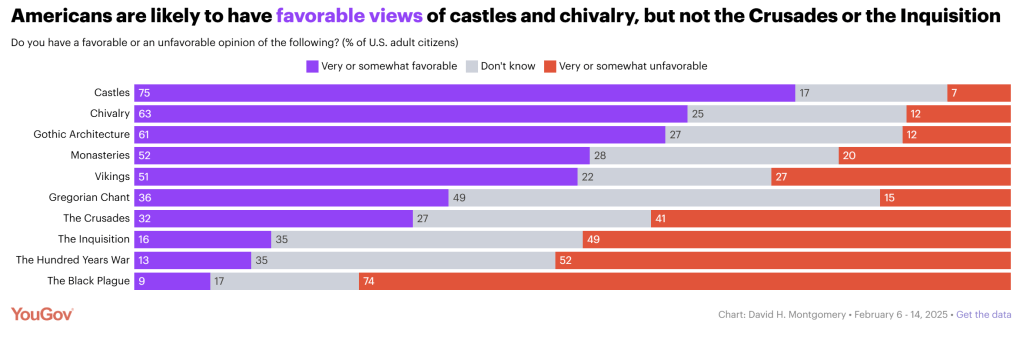
What I love is this section where everyone is pretty much bang on the money. Castles are sweet as hell, it’s so true! Gothic architecture? I love that shit!! YES!!! Also the Crusades, Inquisition, Hundred Years War, and Black Death all suck. I’m not saying they aren’t interesting, I am saying I think that people suffered terribly as a result of them and so you should, in fact, dislike them if asked to do so.


If you are enjoying this post, why not support the blog by subscribing to the Patreon, from as little as  £ 1 per month? It keeps the blog going, and you also get extra content. If not, that is chill too.


I only have a few minor quibbles here. The first, is that I personally don’t count the Inquisition – which you absolutely should have a negative opinion on – as medieval. For me, by the time Ferdinand and Isabella unite Spain, that kingdom is in the modern period. Just like I find the Columbian expeditions to be Early Modern, not medieval. However, I can also accept why people might call it medieval just based on the date. For me, it does feel like it gets called medieval because it sucks though.

The second is identifying chivalry as a nebulous good, when in fact probably people don’t know what it is. I suppose I should be taking all the good press I can get, however.

I also find it super interesting that if you press people about actual individuals who lived in the medieval period, they start admitting that they don’t know what they are talking about. Here we have ten of the biggest names from the period (in Europe, anyway) and most people are like ‘Yeahhhhhh I don’t know her.’ I do think it is cute that people like Joan of Arc a lot though. I think that we gotta drop Richard the Lionheart’s numbers right down though. I am attributing his high favourability to Robin Hood stuff, but I am still taking it seriously that everyone likes him but doesn’t like his mom??? Justice for Eleanor of Aquitaine! Also the nine percent of people who don’t like Hildegard of Bingen – I just want to talk. Who hurt you??

I also love that more Americans say they are thinking about the Middle Ages than the Roman Empire. That is good and proper. Thank you. I do, however, wonder what said people are thinking about, given the weird scores and negativity above, and the fact that they apparently don’t know anyone’s names.

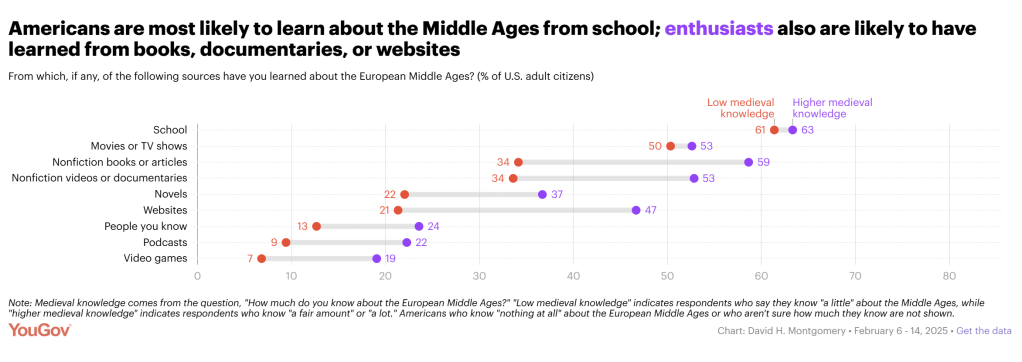
I am also interested in this section of the poll where people say they got most of their information about the medieval period from ‘school’ cuz – girl, when? I went to Catholic school for sixteen (16) years in America. We barely got any information about the medieval period! I was presented with, ‘Hmm yeah, 1066. Magna Carta?? Anyway, here’s the Renaissance’ until I got to uni. I just feel flummoxed by the idea that serious pedagogy on the medieval period is actually happening in America, but that I, a person who hung out with Jesuits for eight years, did not somehow receive it.

Also my feelings on this one are born out by the next couple of polls which show people have no idea what they are talking about.

I mean not even half of respondents can tell you when the Middle Ages were happenoing correctly. Yes, I concede that we don’t have a specific time frame, but as a general rule of thumb 476 to 1517 works as a quick and dirty rule, right? AND YET! Not even half of you bitches can identify 1100 – the most medievaly time that ever medievaled – as the Middle Ages and you are still somehow mad at them?? Come now. Also if you are learning so much about them in school why can’t you define them? CASE CLOSED. (The case is not closed.)

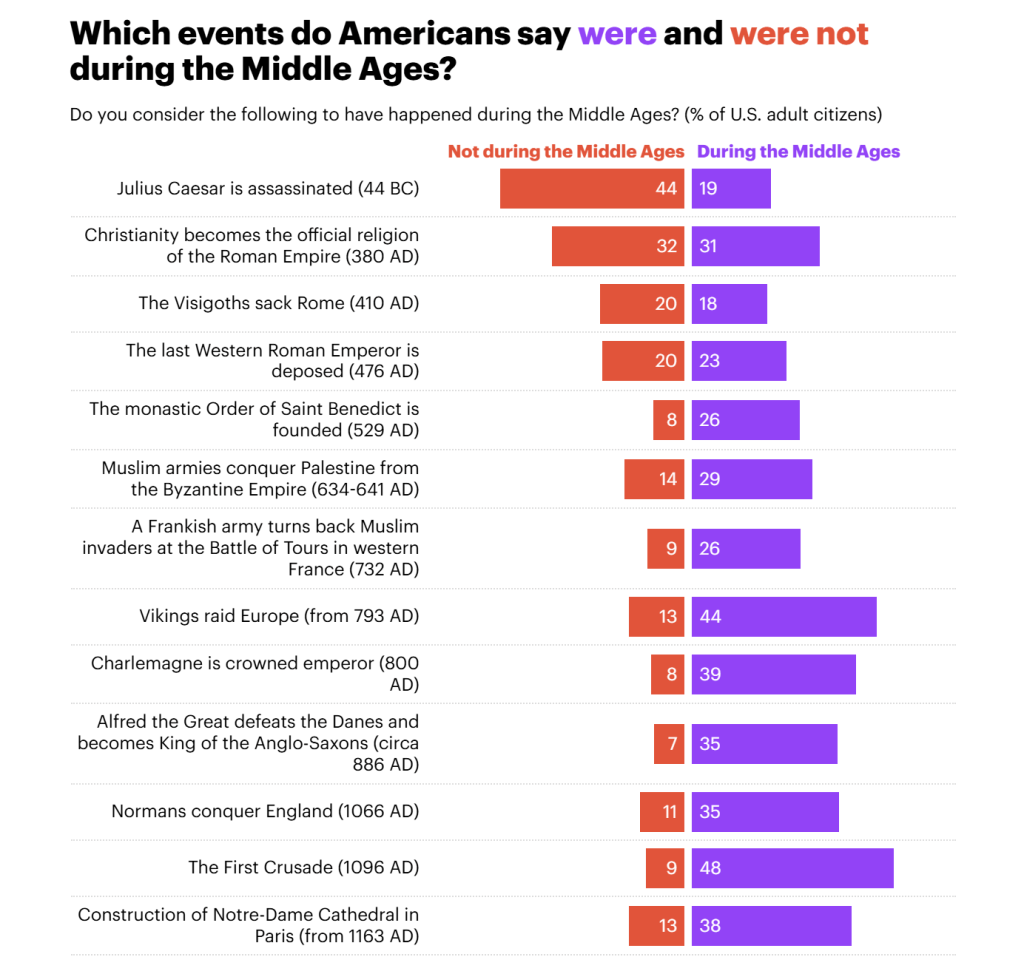
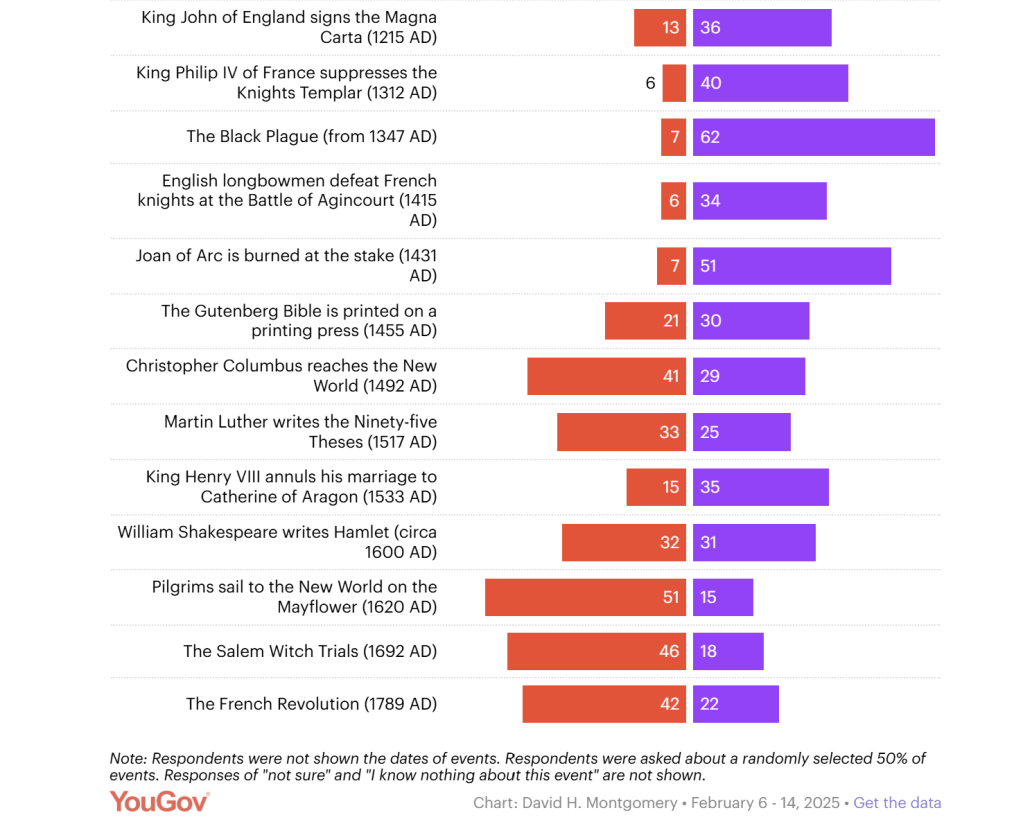
But here is the thing, again, I feel like the people responding to this poll did not learn about medieval history in school, given that the only two events which more than half of people could correctly attribute to happening in the medieval period are the death of Joan of Arc and the Black Death. The same number of people attribute Magna Carta being signed to the medieval period as do attribute Henry VIII getting divorced to the medieval period. These are arguably the two most medieval and early modern things to happen in England during each period, respectively. So forgive me if I don’t take you at your word that you learned about the period in school when apparently thirty-one percent of you think that Rome adopted Christianity during the medieval period.

Now to be fair to those polled, these answers show that, once again, a lot of people abstained from identifying when they felt these events happened, and that is actually really smart and correct. I think that if you don’t know something the smartest thing you can possibly do is just say so.

Still, having said that, if you don’t know about something I think it’s also probably a really good idea to not pass value judgements on it! Would I rather that people know about the medieval period? Yes, obviously that is what I have devoted my life to doing, for some fucking reason. However, if knowing about medieval history isn’t for you, I think the least you could do is shut the fuck up about it being bad. This stuff is above your pay grade, and that is fine.

In order to not meet hateration with hateration, I want to end on a positive note. I think it’s fucking great that younger people are learning more about the medieval period, and are being more nuanced with their evaluation of it. I think it’s great if people are learning about the medieval period in school. (I doubt they are, but still!) I also think it’s cool that the badassery of Joan of Arc manages to cut through hundreds of years. Long may this continue! It makes me feel less alone. I also think it’s great that this poll was conducted at all. Thank you so much to David Montgomery for this food for thought. It helps me what to plan next.


[1] For more on how the time period of the Renaissance was, in fact, a shit show, I cannot recommend Ada Palmer’s amazing new book, Inventing the Renaissance: The Myth of a Golden Age, (Chicago: Chicago University Press, 2025), enough. She’s an actual honest to god Renaissance historian and would be the first one to back me up on all this. Hell, I got half of these opinions from reading her excellent work. Do get it!

[2] https://today.yougov.com/entertainment/articles/51889-violent-dark-dirty-americans-middle-ages, <Accessed 30 April 2025>


For more on misconceptions about the medieval period, see:
There’s no such thing as the Dark Ages, but OK
I assure you, medieval people bathed
On cats
On fake medieval devices both torture and sexual
That’s not what chivalry is, but OK


Support the blog by subscribing to the Patreon, from as little as  £ 1 per month! It’s the cool thing to do!

My book, The Once And Future Sex: Going Medieval on Women’s Roles in Society, is out now.


© Eleanor Janega, 2025

In praise of difficult histories, or, I saw Edward II at the RSC and it was so so so good

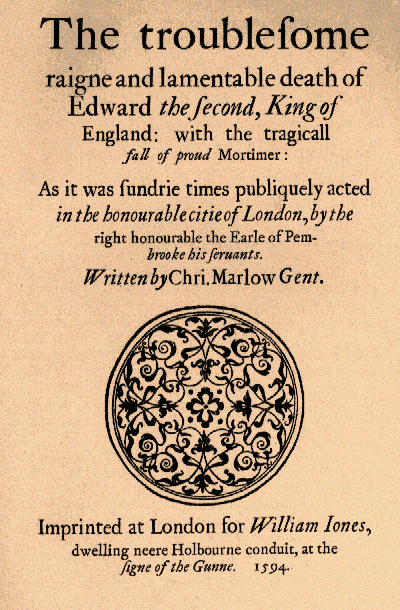
I was lucky enough to get to see a production of Christopher Marlow’s (1564 – 1593) Edward II at the Royal Shakespeare Company this week, and as with any good piece of art I come across, I have been thinking a lot about it since.

Edward II (1284-1327) is one of those historical figures that people don’t really know what to do with, but Marlowe in the sixteenth century decided to take him on, and wrote a startling and nuanced play about the man and his court.

Continue reading “In praise of difficult histories, or, I saw Edward II at the RSC and it was so so so good”

On what we choose to remember

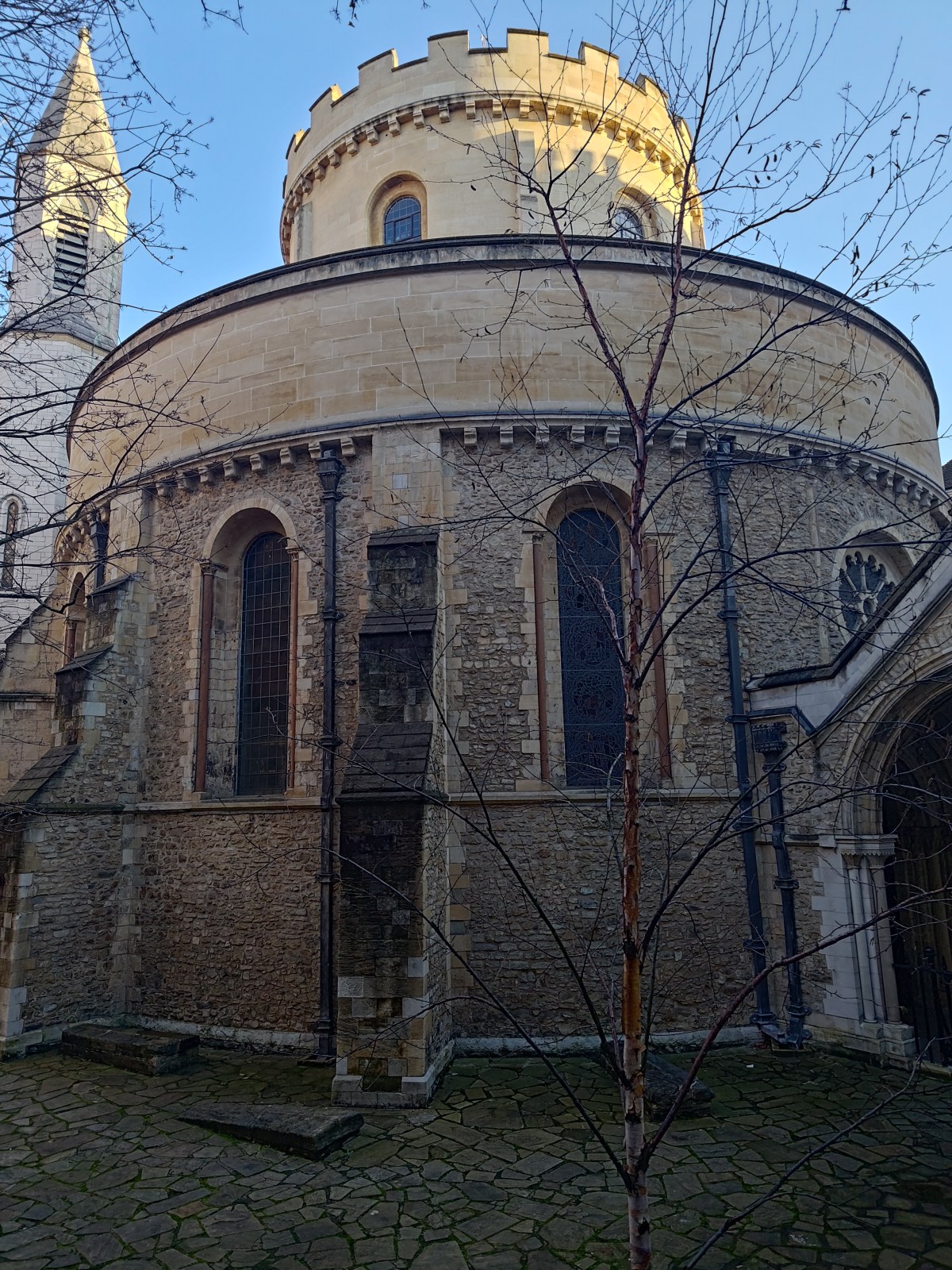
The other day I had the pleasure of ducking into the Temple Church here in London. I’ve been by a number of times, but never actually in, and so I was looking forward to being a little history nerd in a cool old space. Obviously, I am very aware of the fact that the Temple was severely damaged by the blitz, but there’s always something to see in a place like this, so in I went.

Continue reading “On what we choose to remember”

On spooky animals

I’ve been thinking a lot about ghosts lately. No, not because it’s October. That sort of seasonal interest in ghosts is for amateurs, and your girlie is thinking about ghosts 24/7 365. I don’t get ready for spooky season, I am spooky season. Regardless! I was once again enjoying the delights of the Byland Abbey ghost stories and thought it would be a cute seasonal treat for us to consider them all today, because I don’t expect you to be as committed to the creepy girl life as I am.

Continue reading “On spooky animals”

On side hustles

I am adamantly opposed to the conception of grind culture. I swear to god, if you 💯💯💯 me, I will consider it a hate crime, and will report you to my local self-governance group for a reparative harm process. This isn’t to say that I do not understand that work is often required of us all. I am, quite famously, a bitch with five jobs, after all. My point is more that glamorizing having a side hustle – or side hustles – and positing that said side hustles can lead you from financial precarity is dubious at best and problematic at worst.

I say this because, very sadly, the side hustle is not in any way shape or form a new invention. All ones needs to do is check out the middle ages for an absolute treasure trove of people who were working several many jobs. It didn’t really change their lives. Allow me to explain.

Continue reading “On side hustles”

On body count

I’m not really on twitter that much anymore because of all the generalised unpleasantness. I mostly go to let people know I have done something that they can go read, watch, or listen to, and then I scuttle away to fritter my time on other useless pursuits.

And yet, at times there is a post so ridiculous, so incredibly stupid, that it goes up like a bat signal for me specifically, and all my friends that are still on yell at me until I come look at it. The other day there was one such case, and I was pulled out of retirement to gaze upon it in horror.

Here it is:

Continue reading “On body count”

Let me explain something to you: the mendicants

So over at my cute little podcast We’re Not So Different we are currently running a book club for patrons. As a part of this I am rereading the classic The Name of the Rose, which has made me realise one of the arcane pieces of knowledge I possess as a powerful mage medieval historian is an understanding of the mendicant orders, or the begging orders, and I thought it might be helpful to impart it here so you know what I am always going on about. Also you can then read Eco on a nerdier level or whatever.

Continue reading “Let me explain something to you: the mendicants”

On gossip

I had the singular pleasure of visiting with a bunch of my high school friends the other week, and one of them put me on to a podcast I had not heard about before Normal Gossip. She said it was something she thought I would like because, well, a thing about me is that I am interested in gossip – and I mean this in several ways.

Firstly, I mean I am interested in gossip as an academic concept. I like thinking about the way gossip is discussed in medieval sources. Secondly, I also like to think about how gossip is conceptualised by anthropologists, which is to say, I enjoy thinking about what it is that gossip does socially. Because it does a lot. Thirdly, I mean, look, I am a social historian. My job is to gossip about dead people. I sit around and read what they have written, or what was written about them. I rifle through records of their house contents to try to picture how they were living their lives. And I think about who is talking about them in order to try to put together an idea of what they were like – and then I tell people all about it. And like, let’s just be honest – My interest in this means that I am a professional gossip who writes on gossip as a concept and that’s cuz … I want to hear the gossip. You have some? Great, I want it. Is it about some people I have never even met and probably won’t ever meet? Even better. To me, every bit of anonymous gossip is my own private soap opera, and I simply love to hear it.

Continue reading “On gossip”